• Home
  • Acting
  • Essays
  • Etsy Store
  • Contact
  • Bio
  • Photos
  • Zandy Hartig's Artwork
  • Resume
  • Instagram
  • Menu

Zandy Hartig

sketches and painting
  • Home
  • Acting
  • Essays
  • Etsy Store
  • Contact
  • Bio
  • Photos
  • Zandy Hartig's Artwork
  • Resume
  • Instagram

from The Bulwark, 01/22/2025: Revisiting David Lynch's 'Mulholland Drive,' from A City on Fire →

January 10, 2026

THE FIRST TIME I SAW Mulholland Drive was in 2002 while I was visiting Los Angeles for pilot season. My friend’s aunt, whom I didn’t know until that night, had invited me to join her at the Vista Theatre on Sunset. The movie left me utterly discombobulated. It perplexed and disturbed me in equal measure, so much so that I actually felt dizzy. Everything outside looked sinister or compromised. The man smoking a cigarette by the lamppost, what did he know about me? Was that terrifying, filthy bum in the movie lurking in the alleyway behind the theater dumpster? Why did everything around me seem so dark and yet vivid all of a sudden?

My friend’s aunt had kindly reserved a table for us at Jones Hollywood Cafe, but I could barely pay attention to my meal or her. I focused on another booth, a man in his sixties with a pretty woman in her twenties, the orange light engraving the deep lines in his face and accentuating the glow of youth on hers. When he laughed, I could see his big, white teeth, and they seemed ready to devour her. She reminded me of Betty, the ingenue played by Naomi Watts in Act I of the movie, impressionable and hopeful. If I moved out to Los Angeles to pursue my own acting dreams, would I end up like Diane Selwyn—Betty’s alter ego in Act II—bitter and broken? Was the filmmaker sending me a dark-blue key but warning me not to use it to open that Pandora’s box?

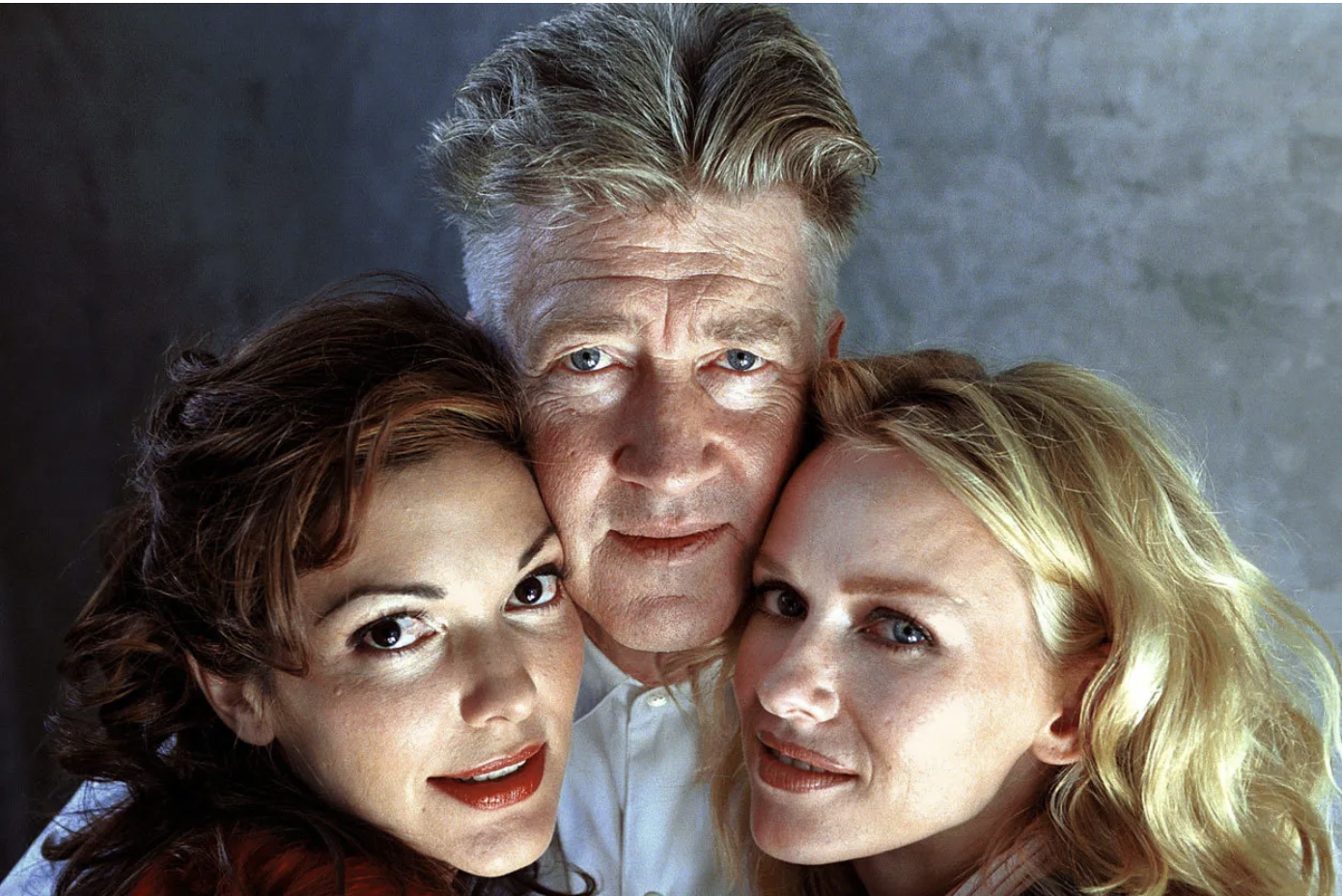
Such is the power of Mulholland Drive, which I revisited this week when I heard the sad news of director David Lynch’s passing after being evacuated from his home during the recent wildfires. Even though the first time I found the film confounding, it left an indelible impression on me, and its mysterious and ominous allure lingered. Whenever I rewatch Mulholland Drive—as I have many times over the years—its meanings bloom and deepen. I now find it, strangely, to be one of Lynch’s most straightforward stories. In the vein of the Brothers Grimm, Mulholland Drive is a dark, perverse fairytale about Los Angeles: the fantasy of Hollywood stardom, the gritty underside of show business, and the liminal space where the two blur together.

As Lynch put it in Catching the Big Fish: Meditation, Consciousness, and Creativity: 

I love Los Angeles. . . . The golden age of cinema is still alive there, in the smell of jasmine at night and the beautiful weather. And the light is inspiring and energizing. . . . It fills me with the feeling that possibilities are available. . . . It was the light that brought everybody to L.A. to make films in the early days. It’s still a beautiful place.

The dream for the golden age of cinema is the Act I of Mulholland Drive. In my mind, it is the fantasy portion of the movie. Personified by bright-blonde “Betty” —an old-fashioned name harkening back to Bette Davis (highbrow), or Betty from the Archie comics (lowbrow)—Naomi Watts comes out to Hollywood with stars in her eyes. In the way Lynch chooses to light and shoot her, she literally glows with optimism. She wears opalescent nail polish and a bright pink sweater with rhinestones so that when she moves, she gleams and glitters. Watts’s performance is so stylized that while I was watching the film the first time I couldn’t believe how syrupy she was. That is until she went into her “big break” audition scene, when all of a sudden she transformed from a wide-eyed innocent into a seductress, fully in control of her scene partner, a seasoned, slick George Hamilton-type, old enough to be her father. I realized it was Lynch’s and Watts’s plan all along to make Betty naïve, perky and over the top in order to stun the viewer in that gritty, sexualized audition scene. A star is born.
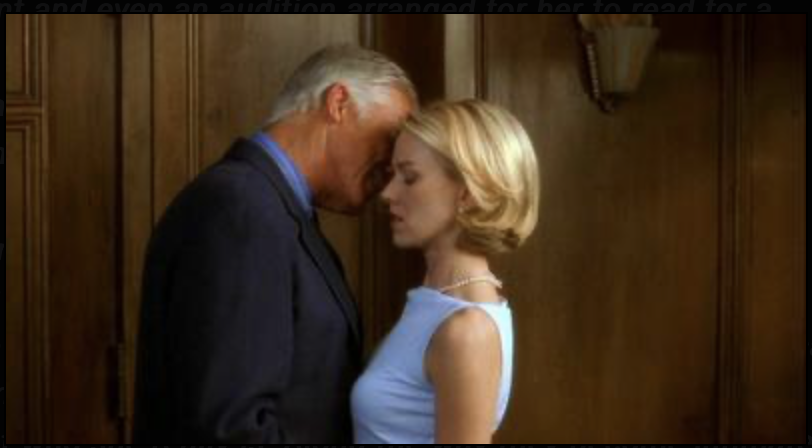
The post-audition Betty also is fully in control of “Rita” (Laura Harring), the mysterious, dark-haired bombshell who wanders away from a deadly car wreck and an assassination attempt on Mulholland Drive without any memory of who she is. Betty is Rita’s heroine, helping the damsel in distress piece together her true identity and protecting her from the dark forces pursuing her. The more Rita depends on Betty, the more they are drawn to each other, and in one of the most tender and sensual scenes I’ve ever seen on film, Betty invites Rita into her bed and seduces her while saying “I am in love with you,” over and over like an incantation. It’s as if Cinderella and Snow White became lovers. They merge into one as they kiss. This time when I watched the scene, there is a shot I am convinced is Lynch’s homage to Persona, where Rita’s profile merges with Betty’s full face.

ACT II OF MULHOLLAND DRIVE is the “reality” section of the movie. Watts is no longer the upbeat starlet Betty but rather Diane Selwyn, a jaded, hard-bitten actress pining for Harring, who is now Camilla Rhodes, a glamorous actress on the rise who is leaving her ex-lover Diane far behind in her quest for fame. Diane is the dependent one in this role. She is talentless and whatever acting jobs she’s gotten have been tossed her way by Camilla. She fantasizes about their time together before Camilla ditched her for a famous director, Adam Kesher (Justin Theroux). The warm remembrances of their lovemaking are gone. All that is left is raw sex and obsession. While Camilla still glows, Diane looks tough and hardened and drained of color. She is shabby in her worn-out bathrobe. She sleeps late into the day, wears no makeup, and her hair is jagged and dirty. Lynch shoots her in a harsh light. She seems to have suddenly developed lines in her face.
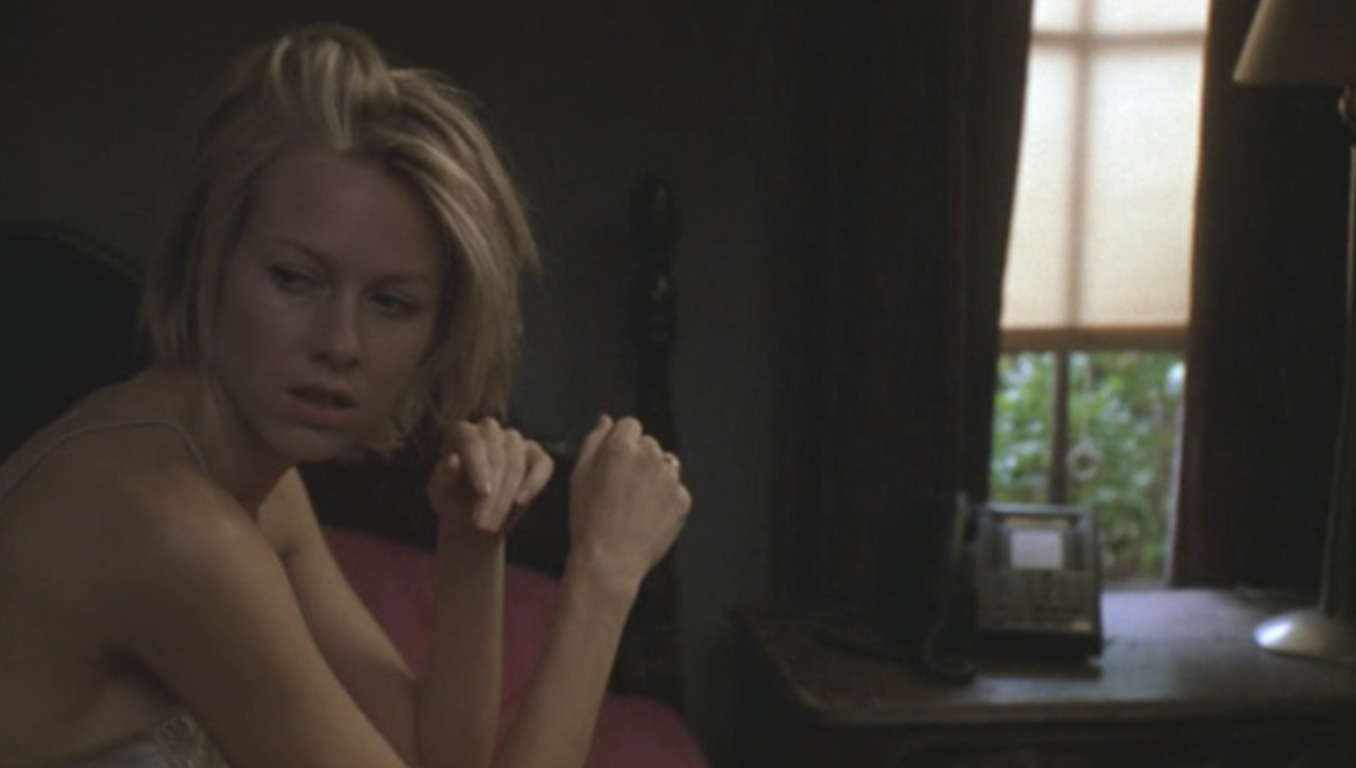
Every time I watch Naomi Watts’s performance here, I am struck by how brave it is. Her masturbation scene is so raw and painful in its vulnerability that I have a hard time watching it. David Lynch must have inspired so much trust in his actress that she felt safe to express herself with such literal and metaphorical nakedness. I am in awe of him and her. 

Whereas the first part of the movie is about the myth of Hollywood, the second part is about its dark, sleazy underbelly. Camilla torments Diane professionally and personally, and Diane’s love devolves into jealousy and hatred. She becomes a bit player in Camilla’s life, both on camera and off. The film’s glamorous Hollywood Regency design in Act I is replaced in Act II by Diane’s slovenly apartment, a flat, painted set background on a soundstage, and Adam’s harsh, angular, modern house in the Hollywood Hills. Instead of being pursued by ominous, enigmatic mobsters, all that’s threatening Diane in the second part of the movie are her poisonous thoughts. And when the hitman Diane hires leaves the blue key on her coffee table signaling that he has successfully completed his task (a basic blue house key compared to the sparkly cobalt, stylized key Rita finds in her purse) she is consumed by agony and guilt for killing her former lover. The old couple whom Betty met on her flight from her hometown to LAX, have now mutated into demons who crawl out from the mysterious blue box held by a dark, hideous bum behind the dumpster, and chase Diane until she shoots herself in the mouth. Diane’s Hollywood dream ends up a seedy, sordid nightmare. The rawest of neo-noirs.

What unites the two sections is that the film begins and ends at night atop Mulholland Drive, a physical and psychological threshold between fantasy and reality. It’s where the Hollywood Hills also begin and end. And so David Lynch makes it the locus: where Camilla is killed off (whether literally or metaphorically, depending of one’s interpretation) and “Rita” is born. Knowing Lynch’s dedication to Transcendental Meditation and his belief that the spirit can never be destroyed, I think he intends Mulholland Drive to be the place where this transition from life to death, from corporeality to make-believe and back again, happens.
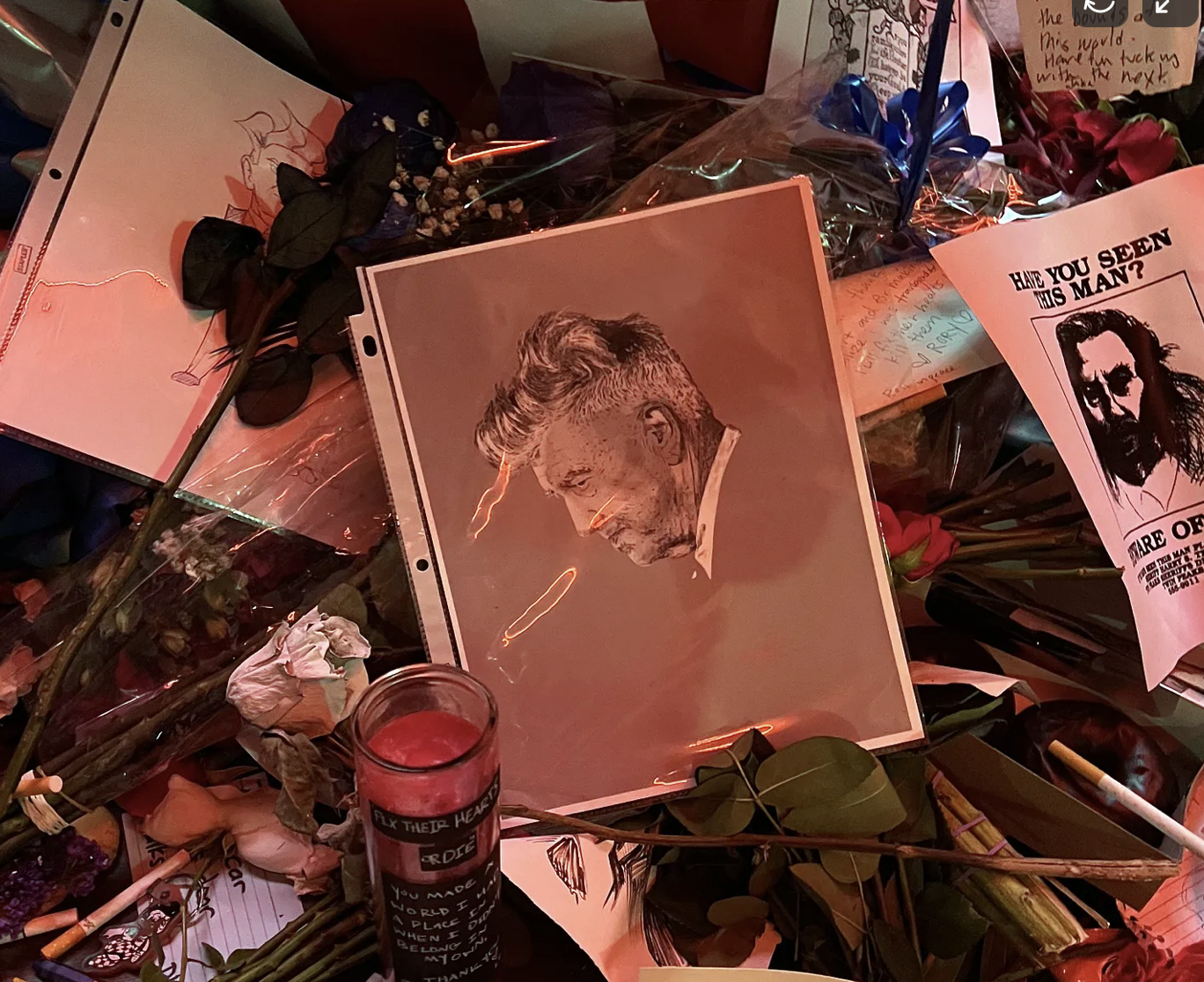
A spontaneous offrenda, of sorts, left at Bob’s Big Boy, one of David Lynch’s favorite local spots for a cup of coffee and a slice of pie.

IT’S NO SURPRISE TO ME that David Lynch actually lived in a blue house that veered off this infamous road. Los Angeles, represented by Mulholland Drive, is a dark path, full of twists and turns and peril. We have sadly seen this the last few weeks in the devastation of the L.A. wildfires. But the glittering lights down below in Hollywood are omnipresent. 

Mulholland Drive is David Lynch’s twisted love letter to L.A. In his view, you can’t have light without the darkness, you can’t have joy without pain. And recently, watching helplessly as neighborhoods were consumed by fire, I realized I love this place more than I’d thought. As a formerly reluctant transplant and a struggling actress with big dreams myself, I now willingly call it my home. Los Angeles opens up its sensuousness to its pioneering inhabitants like the night-blooming jasmine at midnight. Angelenos just have to appreciate its particular complexity, mystery and contradiction the way Lynch did. As a director famously beloved by his actors and coworkers, and to whom many owe their illustrious careers, David Lynch became a legendary part of the Dream Factory that drew so many people, himself included, out to Hollywood in the first place. His energy will linger on in the Los Angeles light he loved so much.

Comment

from The Bulwark, 11/14/2025: The Upside of the Lowdown

January 10, 2026

FULL DISCLOSURE: I have a real soft spot for Oklahoma, having worked there several times and having loved the people I’ve met while working, so I am inclined to relish The Lowdown (now finishing up its season on FX). But even if I’d never stepped foot there, I would still admire writer-director Sterlin Harjo’s new show for the genuineness, quirkiness, humor, and melancholy lying beneath its Sooner State clay.

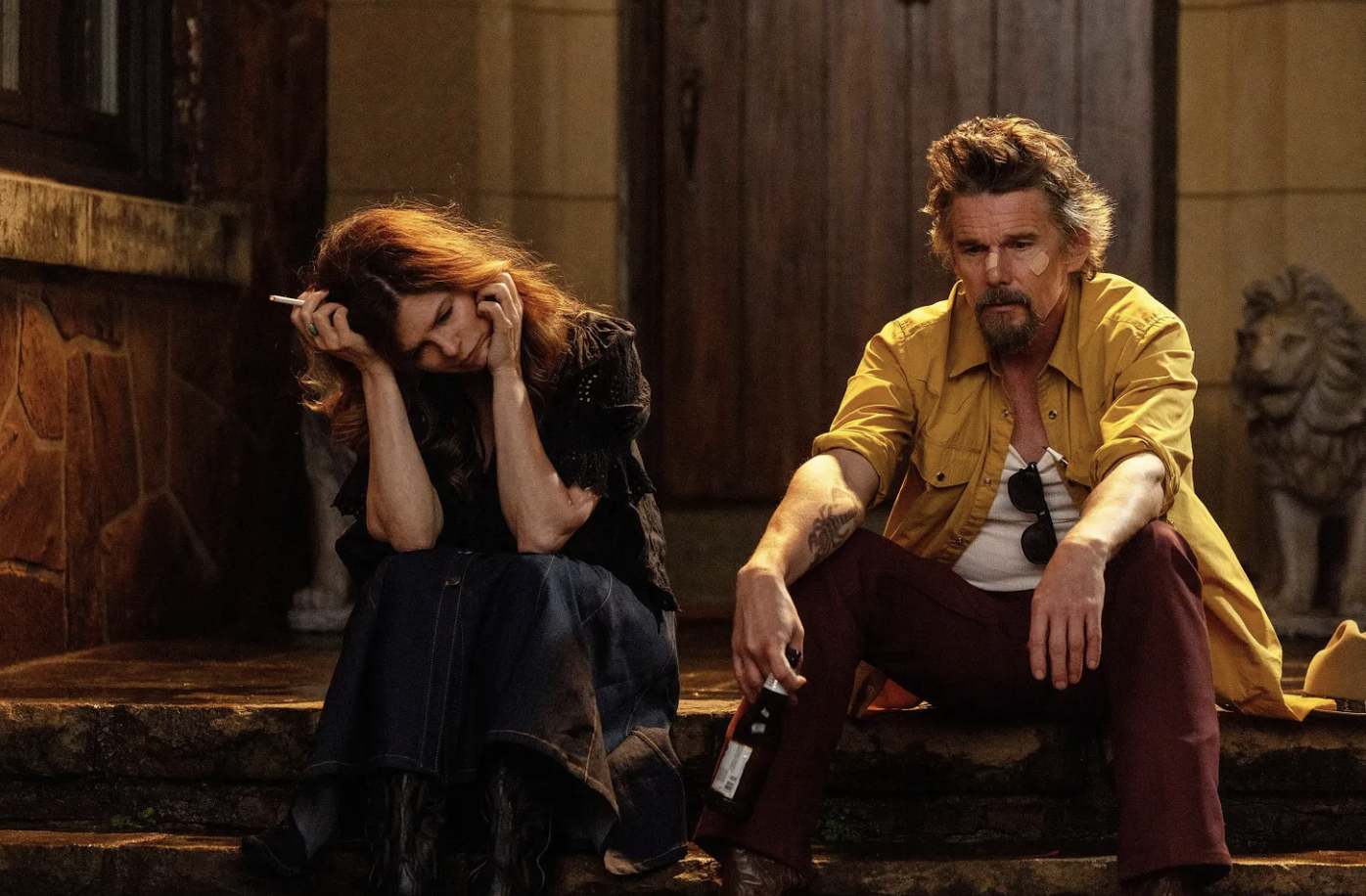
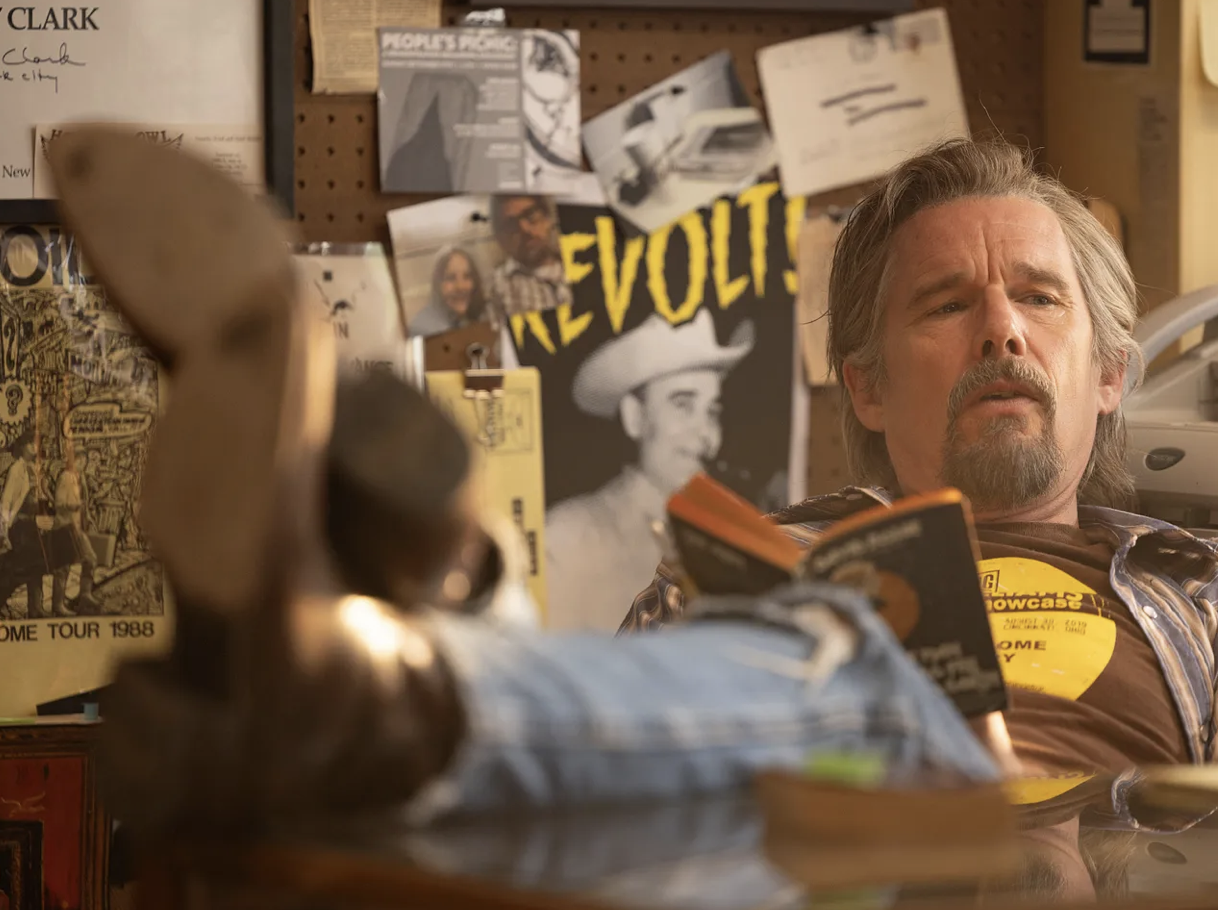
Lee Raybon (Ethan Hawke) is a rare-books dealer in Tulsa, and a self-described “truthstorian,” which he defines thus: “I read stuff, I research stuff, I drive around and I find stuff. Then, I write about stuff. Some people care, some people don’t. . . . Let’s just say I’m obsessed with the truth.” He is chronically injured, broke, and somewhat hapless, but he’s undaunted in uncovering the seedy underbelly of “respectable” Tulsans, notably the most influential family in town: the Washbergs. One Washberg, Donald (Kyle MacLachlan), is running for governor; his black-sheep brother Dale (Tim Blake Nelson) was a closeted oddball who may or may not have committed suicide. Lee is determined to investigate Dale’s death, and along the way unearths a more sinister layer of corruption and greed tied to white nationalism that threatens to eradicate North Tulsa’s black and Native-American community, in addition to Lee himself.

In Sterlin Harjo’s skillful and imaginative hands, what could be dark and dispiriting is, mercifully, not. Like Harjo’s previous show, Reservation Dogs, The Lowdown is rollicking and sometimes rambling, but is always bright, fun, and entertaining. The scripts are clever, the repartee between characters is fast-paced and witty, and the cast is a delightful combination of both novice and seasoned actors, several hailing from Tulsa itself, including Tim Blake Nelson, Tracy Letts, and Jeanne Tripplehorn.

“Authenticity” is the word that comes to mind about this series. Harjo knows all the nooks and crannies of Tulsa and its environs, and he wants his viewers to get comfortable with them as well. We go from North Tulsa to rural countryside, from mansions to public housing, from cookouts to honky-tonk bars, from cattle auctions to the Italianate gardens of the Philbrook Museum. We see the whole range of humanity in Tulsa too, from misguided do-gooders like Lee, to religious extremist Nazis hellbent on domination. Everything under the vast, open Oklahoma sky is ripe for examination. Harjo doesn’t shy away from Tulsa’s seedier side or its complicated history—its Reign of Terror on the Osage Nation and the Tulsa Race Massacre in Greenwood—but he also has great affection and tolerance for his city. As his teenage daughter Francis (Ryan Keira Armstrong) says to Lee, “The way you write about Tulsa, there’s bad things about it, but underneath, it’s really good.” Lee Raybon is a personification of Tulsa: messy, a bit worse for wear, but full of heart and fervor, surviving sometimes despite himself. There is an ease with which Lee relates to all the business owners in town, from the literary editor of the Heartland Press to the decidedly lowbrow editor of the Tulsa Beat—“You read my paper?” asks Cyrus (“Killer Mike” Render), “It’s booty and bad guys.”—Lee approaches all of them the same way, asking for forgiveness and begging for favors.

THE LOWDOWN DOESN’T SHY AWAY from intellectualism; in fact it runs toward it with open arms and dares to meld the intellect to Oklahoma’s cowboy spirit so that it becomes homey and even rebellious. The intellect isn’t something pretentious or effete, it’s active and enriching. And is in complete opposition to the dead-eyed Nazi preacher (Paul Sparks), demanding thoughtless devotion and vengeance from his cult-like congregation (yeah, it rings an eerie and unsettling bell for me as well). Lee’s articles drive real change and hopefully march toward cultural and political progress. The cultural-intellectual life and politics go hand in hand on this show. Lee’s “sidekick” and his savior, private detective Marty (Keith David), quotes Percy Bysshe Shelley. Dale Washberg, who cherished his complete first-edition collection of Jim Thompson crime novels, becomes like a Thompson, neo-noir character himself after his death. While reading his secret writings, Dale speaks to Lee from the grave in surrealistic, poetic monologues about his complex, hidden life and the circumstances of his death, which help Lee and others solve past and present crimes. And in the end, Lee, a rare-book lover, saves the day—with plenty of help from non-literary folks in his orbit—and rides off into the sunset on his white steed (well, in his white, busted-up van).

As a murder mystery, it falters. The detective work of solving who-did-what-to-whom isn’t what captivated me. What I loved was the huge assortment of personalities Lee encounters all along his adventures, like an Okie Gulliver’s Travels. In fact, there are so many characters sometimes that it’s hard to keep track. The Lowdown is a friendly, garrulous uncle who repeatedly references people you hardly know as if you are intimately familiar with them: “Wait, whoare you talking about now?” But that’s also part of its charm. There are so many wonderful performances, but some standouts are Kyle MacLachlan as the fragile-egoed, compromised politician, Michael Hitchcock as a gossipy local antiques dealer, Dale Dickey as a beaten-down mom in survival-mode, Tracy Letts in a role I won’t explain (you can thank me later), and Jeanne Tripplehorn, who along with Ethan Hawke and Tim Blake Nelson, are the beating hearts of the show. Tripplehorn turns what could have been a stereotypical femme fatale—the widow with secrets—into a fully fleshed out portrait of someone who has survived and thrived through grit, determination, looks, and smarts. There is a soulful and mournful quality to her performance. She makes what in lesser hands could be a two-dimensional role a real, fleshed-out, vibrant woman. When you watch the coda of the finale, you’ll see exactly what I mean.

Like Jeanne Tripplehorn’s performance, The Lowdown’s melancholy underneath its liveliness and good humor is enchanting. A sense of loss and loneliness permeates the series, and gives heft to its jocular storytelling. Lee is still in love with his ex-wife, who also still loves him, even though she is trying to make a new life with a more stable man. He wants to be a solid father-figure to Francis, but Lee knows he’s constantly falling short and that his daughter, though thirteen, is more emotionally mature than he is in his fifties. His scenes navigating fatherhood with Francis are touching and honest. Lee is battered and bruised fighting bad guys, but he is also beaten up by self-destruction and living hand-to-mouth. No matter how many people Lee surrounds and distracts himself with or how many rabbit holes he clambers down, at the end of the day he still sleeps alone in the attic on a mattress on the floor of his bookstore. Ethan Hawke’s metamorphosis from clean-cut leading man in his early career to edgy character actor in middle-age is truly impressive, and in The Lowdown this grizzled transformation works beautifully for him.

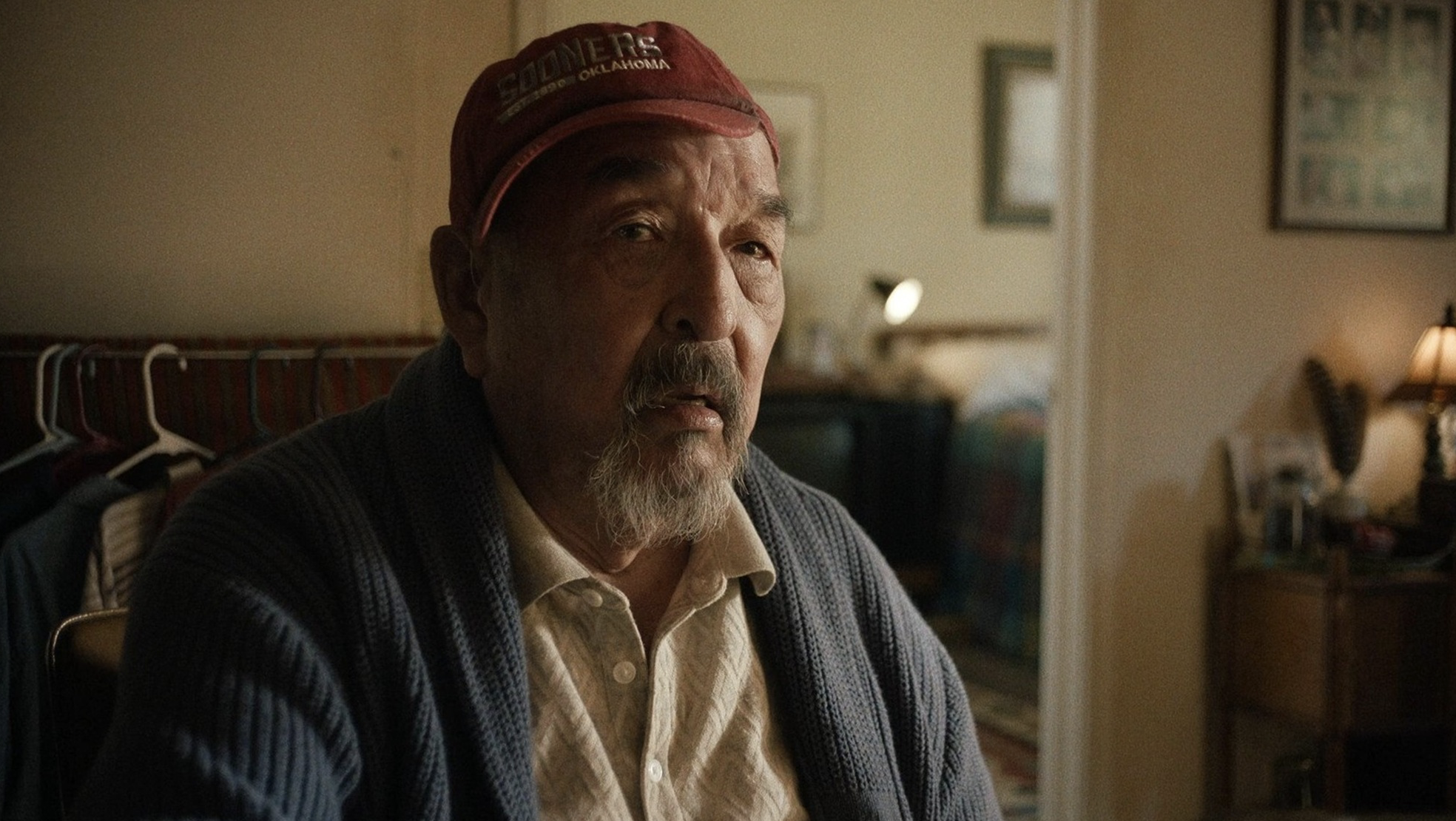
And I’d be remiss if I didn’t mention Graham Greene in his final performance. As usual and as always, it is stunning in its simplicity and directness. Almost painful, knowing it was his last, and Sterlin Harjo dedicates the episode, “Old Indian Trick,” as a tribute to him. It brought tears to my eyes.

With Reservation Dogs, and now The Lowdown, Sterlin Harjo wants us to know that Oklahoma isn’t flyover country. He asks us to delve deeply into Oklahoma’s history and nature, both the good and the bad, and recognize that Tulsa is a culturally rich, vibrant town, filled with humor, heart, and bittersweet longing. Oklahoma’s new state motto is, “Imagine That,” and in The Lowdown, Sterlin Hajo’s imagination does exactly that.


Comment

from The Bulwark, 04/10/2025: Nihilism at The White Lotus -- Season 3 Review

January 10, 2026

LET ME START OFF BY SAYING something positive: In the past, I have adored Mike White’s body of work. I consider Freaks and Geeks, Enlightened, Year of the Dog, Chuck and Buck, as well as the first two seasons of The White Lotus to be subtle, edgy, funny, nuanced, and thought-provoking. But as the credits rolled on the finale of The White Lotus’s third season (streaming on Max), I said out loud to my TV screen, “Are you f-ing kidding me?” I am legitimately confused—to the point of anger—by this entire season. I’m left to conclude that this series may have jumped the monkey.

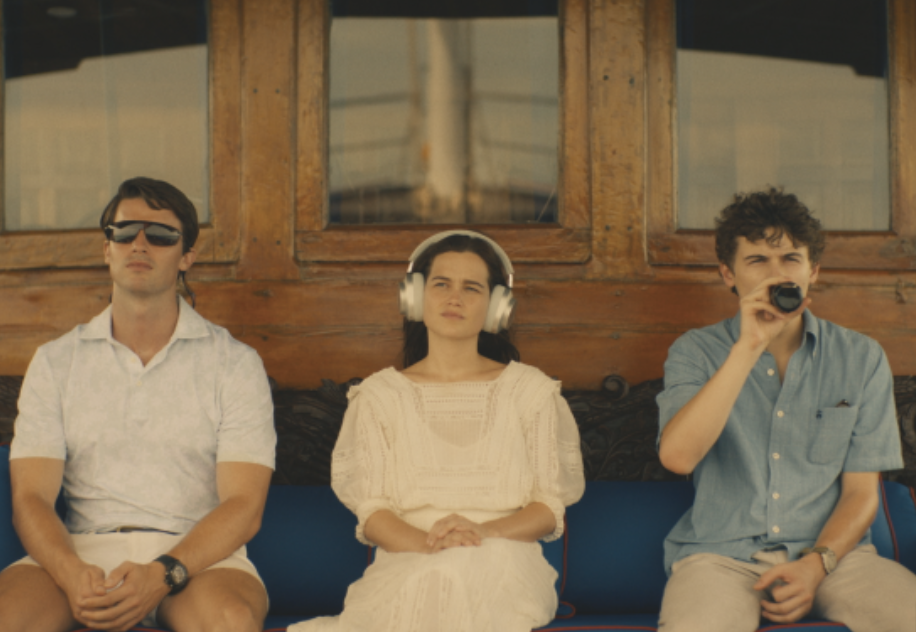
So many monkeys, so little meaning. They are in almost every cutaway, lurking, watching behind the scenes on the hotel grounds, occasionally howling. I get it: I felt the same way watching this group of insufferable people interact with each other for eight episodes. Do the monkeys represent humans’ base animal instincts that we pretend don’t exist and try to conceal with education and material success? Do they stand for the menace lurking underneath the surface of this luxurious Thai hotel? Or are they just there so that Rick Hatchett (Walton Goggins) can tell his girlfriend Chelsea (Aimee Lou Wood) after he confronts the person he thinks ruined his life, “I finally have the monkey off my back”—a season-long pun in the making? Who knows? To me they seem more like another animal: a red herring. A red herring in a sea full of red herrings that just swim in circles.

For being a whodunit, season three of The White Lotus is almost devoid of action. Every other scene has a main character staring deeply into the middle distance as portentous kettle drums and discordant background music swell to make sure the audience knows these characters are battling with difficult life choices. Unlike the haunting soundtracks in seasons one and two, season three’s is melodramatic and unearned, more appropriate for an episode of Survivor (a reality show in which Mike White participated) than a season of prestige television.

And when there is dialogue, it’s irritatingly obvious and expositional. “We are soulmates, we are tied together forever,” Chelsea says over and over to Rick. “I’m going to help you get your joy back, even if it kills me,” she says at another point. Guess how that will turn out for them in the end!

Timothy (Jason Isaacs), the paterfamilias of the noxious Ratliff family, exclaims to the hotel manager straight off the boat, “[My daughter] is a religious studies major, so she’s writing her thesis—what’s your thesis on, Piper?—well, it’s on Buddhism, and there’s a monk and a monastery near here, anyway, she wants to interview him, so we made a family road trip of it.” Okay, thanks for laying all that out for us so neatly.

WHAT IS THE MESSAGE Mike White wants to tell about this particular hotel in this particular place? I honestly don’t know. What happens here could happen anywhere, and Thailand seems beside the point. In previous seasons, the locale was an implicit and explicit part of the story. The first season took place in Hawaii, where we felt the culture clash between native Hawaiians and the rich American tourists who disrespect their culture and use the island to suit their own pleasures. Sicily was the setting for season two, where the luxury of Taormina is a paper-thin veneer of civility over the seductive and perhaps sinister nature of that capricious island. The rich Americans vacationing there are seduced and abandoned, duped and unsettled by Sicilians, who take advantage of their guests’ naïveté and arrogance. And they reject the American notion of reconnecting with the mother country as a sort of reverse colonialism.

But aside from sumptuous shots of nature and the endless monkey cutaways, season three neglects Thailand’s allure and traditions. Rather than lush, mysterious, and spiritual, its setting feels claustrophobic. We rarely leave the grounds of the hotel. And when the characters do, what they experience of Thai culture is generic. The Thai actors themselves seem like placeholders instead of fully realized individuals. As the audience, we have no idea how the staff feels about their guests.


Fabian tells Rick and Chelsea that the wellness program at the White Lotus is “the best in the world,” and then aside from some therapy, massage, and yoga sessions, that idea goes by the wayside. What could have been a compelling examination of the wellness industry—its hopes and hypocrisies, the virtues and vices of its denizens—becomes another missed opportunity. Yes, we do get a brief glimpse of life in a Thai monastery, but the dialectical tension between spirituality and materialism is handled like a freshman 101 class in Buddhism. From the creator of Enlightenment, the lack of spiritual depth is one of the most mysterious and annoying aspects of this season of The White Lotus.

And this season’s nihilism is the other big frustration. I appreciate Mike White’s dark humor, irony, and even cynicism, and I never expect neat, happy endings from him—but I do expect complexity, compassion, and humanity. Season three’s casual cruelty caught me off guard. Carrie Coon’s character is put through the emotional wringer and is made to apologize and vaguely grovel to her two frenemies who treated her quite badly. Timothy almost poisons his entire family, yet one scene later he is on the departing boat, composed and recovered. Gaitok, the thoughtful, virtuous security guard goes against his gentle nature and chooses violence to advance in his career, thereby winning the hand of the superficial girl he pines for. Belinda (Natasha Rothwell), whose pain we felt viscerally in season one when Tanya dropped her as a business partner in the wellness practice they planned together, does the exact same thing to her Thai lover in season three, except he just accepts it with a warm smile as she leaves to go back to Hawaii, a new multimillionaire. We believed Belinda to have a spiritual and moral core, but psych! By Belinda taking Greg/Gary’s $5 million in hush money, Mike White apparently proves us wrong.

Yes, there are some very funny and cogent moments this season (as a Tar Heel, I certainly do appreciate all the explicit Duke hatred), but Mike White ultimately plays us for fools and suckers, and to me, this feels reductive and cheap for such a talented creator. He kind of dares us to loathe almost everyone, which I suppose is bold in its way, but I find it to be more contrary than clever in its execution. Few of the characters have significant emotional journeys, and we as an audience discover very little about them. It’s fitting that the song playing over the closing credits is Billy Preston’s “Nothing From Nothing (Leaves Nothing).” As an admirer, I just expect more from Mike White than a sour taste left in my mouth.


Comment

from The Bulwark, 07/29/2025: No Lyin' to Lyonne -- Poker Face, Season 2 Review

January 10, 2026

BOY, I DIDN’T KNOW EXACTLY HOW MUCH I needed the second season of Poker Face (which finished up its run on Peacock). Every episode is delightful, witty, and diverting, without ever glossing over the darker aspects of human nature. Like its patron saint, Lieutenant Columbo, Poker Face’s friendly, discombobulated heroine upholds her integrity in a world roiling with deception, jealousy, and greed. Her curiosity about people and her compassion are what suck her into sticky situations, but her innate commitment to truth and justice compels her to unearth the mystery each episode’s perpetrator tries to bury.

Natasha Lyonne plays Charlie Cale, whose eccentric, befuddled spirit belies an uncanny and laser-focused talent: the ability to tell without fail whether someone is lying. Charlie’s exclamation, “Bullshit!” is her version of Lt. Columbo’s, “Just one more thing. . .” Like Columbo, Poker Face is not a “whodunit” but a “howcatchem”: We see the murders occur before our protagonist appears on screen. But unlike Lt. Columbo, Charlie is outside the law, trying to remain under the radar as she runs away from both the mob and the FBI. Out of habit and necessity, Charlie is a loner with a quasi-vagabond existence, unperturbed and free from responsibility. Despite her lone-wolf ethos, Charlie is anything but a misanthrope. She is fascinated by human beings and their motivations. And since people are complicated, trouble has a way of finding her. As she travels from town to town across the United States, picking up odd jobs along the way, Charlie becomes entangled with tricky personalities and the messy relationships that come with them.

One of the many pleasures of this series is the work done by casting directors Mary Vernieu and Bret Howe (who also worked on the Knives Out! movies directed by Poker Face creator Rian Johnson). The guest stars are almost uniformly inspired choices. Much like Peter Falk did in Columbo, Lyonne has the generosity of spirit to let her costars, both well-known and unsung, shine in their own right. There are so many standout performances in this second season: Cynthia Erivo (playing five different characters in one episode), Gaby Hoffmann, Richard Kind, Kevin Corrigan, James Ransone, Sam Richardson, Corey Hawkins, Awkwafina, Method Man, Patti Harrison, Margo Martindale(!), Carol Kane(!!) and John Sayles(!!!), just to name a few.

My favorite episode also has my favorite acting. “The Sleazy Georgian,” guest-starring John Cho and Melanie Lynskey, plays like a piece of theater rather than a TV show. Minus establishing and closing shots, the episode takes place wholly inside—in a bar of a midlevel hotel and in one of the hotel rooms. Most of the scenes are two-handers and rely on dialogue rather than action. Normally in television, “see, don’t tell” reigns supreme, but in this particular case the intelligence and tension of the acting and Megan Amran’s writing was so masterful that I was entranced by the words alone. I feel deeply for Lynskey’s character, who desperately wants to escape the confines of her prescribed life, yearning for love and adventure. And when Lyonne matches wits with Cho, the TV set practically crackles. It’s a tour-de-force performance from Cho, a consistently versatile and brilliant actor who flies under many people’s radar. The delight of this episode is in its twists and turns so I don’t want to give anything away, but Cho has been gifted with a part that showcases his range, smarts, and subtlety.

Another standout episode involves a uniquely New York City issue: how someone will literally kill to live in a rent-controlled apartment (Alia Shawkat delivers a coup as the murderous tenant). Another involves a screenwriter’s life becoming the embodiment of the movie he reveres the most: Michael Mann’s Heat. And another features an intricate plot involving Justin Theroux as an infamous international hitman (or is he?). Theroux, with a huge assist from the episode’s expert writing and direction, is able to show off his acting chops and his physical grace. And I loved seeing Carol Kane on my TV screen again! She and Lyonne are perfectly matched technically and physically; in fact, with their shared eccentricities and masses of curls, they could be mother and daughter. What a delight.

It’s clear that both Lyonne and Johnson love actors of all stripes. Whether Lyonne is acting with a 77-year-old pro like Rhea Perlman (as the head of a mob syndicate) or a preternaturally talented 12-year-old like Eva Jade Halford (as a diabolical fourth grade star pupil), she gives each equal respect and weight. And although her portrayal of Charlie is full of quirks and mannerisms, her character is always grounded in reality, humor, and pathos. Charlie is a loner, yet she craves human connection. Even mid-season when she is (briefly) no longer on the run, she’s a restless, wandering soul. Each episode, she tries on for size another place and group of people, but because of fateful circumstances, none of them fit. She begins a romance that actually seems promising until her date ends up a murder victim. Her most consistent connection is with the disembodied voice of a long-haul trucker on her CB radio named Good Buddy (Steve Buscemi), who gives her life advice and lends her his apartment in Brooklyn since he’s hardly ever there. Like most mutant powers, her bullshit detector is both a blessing and a curse. It protects her, but it also keeps her from letting things lie and not becoming enmeshed in other people’s problems. The only person who consistently cares about Charlie’s wellbeing is Agent Luca Clark (Simon Helberg), but he can’t be a true friend since he’s been charged with bringing her into FBI custody. In NYC, she attempts to put down roots and rest awhile. She even starts forging a potential deep friendship/partnership. But Charlie isn’t suited to stability and stasis. Soon enough, she’s peripatetic, running from and toward danger again. Amiability and loneliness go hand-in-hand for Charlie, and it’s one of the reasons she’s such a compelling, sympathetic person.

Poker Face’s second season is a knockout in terms of execution. I could go on and on extolling the virtues of its cinematography, direction, editing, set and costume design, and music composition. But what I love just as much is its heart. It’s the perfect pairing of style and substance. When cruelty, lies, and avarice assault us on a daily basis, it’s a relief to escape into a TV show where the heroine calls bullshit on all of it. She cannot help being honest and caring about people. As hard as she tries to disengage, her essential compassion and good nature force her to fight against injustice and to help the helpless, even at her own expense. Charlie’s bright red hair is lit from behind in nighttime scenes, giving her a sort of neon halo. She’s the embodiment of Good Trouble. And even though it’s wish-fulfilment on my part, I relished watching Charlie’s empathy and truthfulness win the day again and again for these twelve episodes. It was a great antidote to real life.


Comment

Archive

  • 2026
    • Jan 10, 2026 from The Bulwark, 01/22/2025: Revisiting David Lynch's 'Mulholland Drive,' from A City on Fire
    • Jan 10, 2026 from The Bulwark, 11/14/2025: The Upside of the Lowdown
    • Jan 10, 2026 from The Bulwark, 04/10/2025: Nihilism at The White Lotus -- Season 3 Review
    • Jan 10, 2026 from The Bulwark, 07/29/2025: No Lyin' to Lyonne -- Poker Face, Season 2 Review
  • 2025
    • Jan 23, 2025 Why ‘My Brilliant Friend’ Resonates Beyond Italy (from The Bulwark, January 13, 2025)
  • 2024
    • Nov 16, 2024 'Evil' Comes to an End (from THE BULWARK, 09/20/2024)
  • 2023
    • Dec 2, 2023 ‘Oldboy’ and the Art of Preparing Your Audience for the Unexpected
    • Dec 2, 2023 Ryan Gosling: A Professional
    • Dec 2, 2023 ‘Risky Business’ Forty Years Later: The Movie That Made Tom Cruise "Tom Cruise."
    • Dec 2, 2023 Poker Face takes viewers back to the 1970s, temperamentally, every Thursday.
    • Apr 14, 2023 Ubu Roy
    • Jan 16, 2023 Portrait of Postpartum Depression in ‘Fleishman Is in Trouble’ from The Bulwark 1/11/23
    • Jan 9, 2023 The Case for ‘The Family Stone’ from The Bulwark, 12/23/2022
    • Jan 9, 2023 The Renewed Relevance of ‘Rosemary’s Baby’ from The Bulwark, 10/31/2022
    • Jan 9, 2023 ‘Belle de Jour,’ an Un-Erotic Masterpiece, from The Bulwark, 03/30/2022
    • Jan 9, 2023 ‘The Sentinel’ at 45: Terribly scary, with emphasis on "Terribly," Bulwark, 1/11/2022
    • Jan 9, 2023 The 1970s: A Down and Dirty Decade of Horror Filmmaking - from The Bulwark, 10/30/2021
  • 2019
    • Dec 14, 2019 Oaxaca
    • Mar 22, 2019 Fire Island
  • 2018
    • Dec 10, 2018 Goodbye, My Brother
    • Sep 20, 2018 I'm Sorry
    • Jun 23, 2018 You Can Judge a Book By Its Jacket
  • 2017
    • Oct 24, 2017 The Pickup Artist
    • Aug 31, 2017 Emergency Style Tips for Men If They Ever Want to Have Sex with A Human Being
    • Aug 25, 2017 Puppies vs. Trump
    • Aug 25, 2017 Puppygate
  • 2016
    • Jul 6, 2016 The Wrong Side of 40
    • Apr 28, 2016 Prince
    • Jan 23, 2016 David Bowie
    • Jan 13, 2016 The Force Awakens: One Woman's Conversion
  • 2015
    • Aug 3, 2015 The Odeon
    • May 11, 2015 Brother Theodore
    • Apr 22, 2015 Amy Pascal and Jezebel